Responsible gambling tools at crypto casinos: what good looks like in 2026
Loss limits, self-exclusion, cooling-off periods and reality checks compared. What crypto casinos typically offer, what is missing, and how players can fill the gaps themselves.
Regulated online casinos in many countries must offer a standard toolkit of player-protection features. Crypto casinos, many of which operate under lighter regimes, vary enormously: some offer a full set, others a single self-exclusion button buried in a support article. This piece sets out what a good toolkit contains and how to compensate where a site falls short.
Why it matters more in crypto gaming
Crypto games combine several risk factors: rounds that last a second, auto-bet features, 24-hour availability, and balances shown in tokens rather than cash. None of that makes them uniquely dangerous, but it does mean the brakes have to be built in, because the natural stopping points of a physical casino are absent.
The toolkit, tool by tool
| Tool | What it does | Good implementation | Weak implementation |
|---|---|---|---|
| Age gate | Blocks under-18s | Confirmation before any play, plus checks at withdrawal | A checkbox in the terms |
| Loss limit | Stops cash bets after a set loss | Set in the account; increases take effect only after a delay | Raised instantly, or only via support |
| Deposit limit | Caps money in per day/week/month | Self-service, with a cooling-off delay on increases | Absent |
| Self-exclusion | Blocks play for a period | Cannot be shortened once set; blocks deposits too | Can be cancelled immediately |
| Time-out | Short break (24 h to 6 weeks) | One click from the game screen | Absent |
| Reality check | Pop-up showing time and net result | Every 30–60 minutes, configurable | Absent |
| Help links | Signposts to support services | Visible on every page | Hidden in the terms |
The single most important design rule: changes that let you gamble more should be slow, and changes that let you gamble less should be instant. A loss limit that can be raised immediately is a speed bump, not a limit.
What we typically see
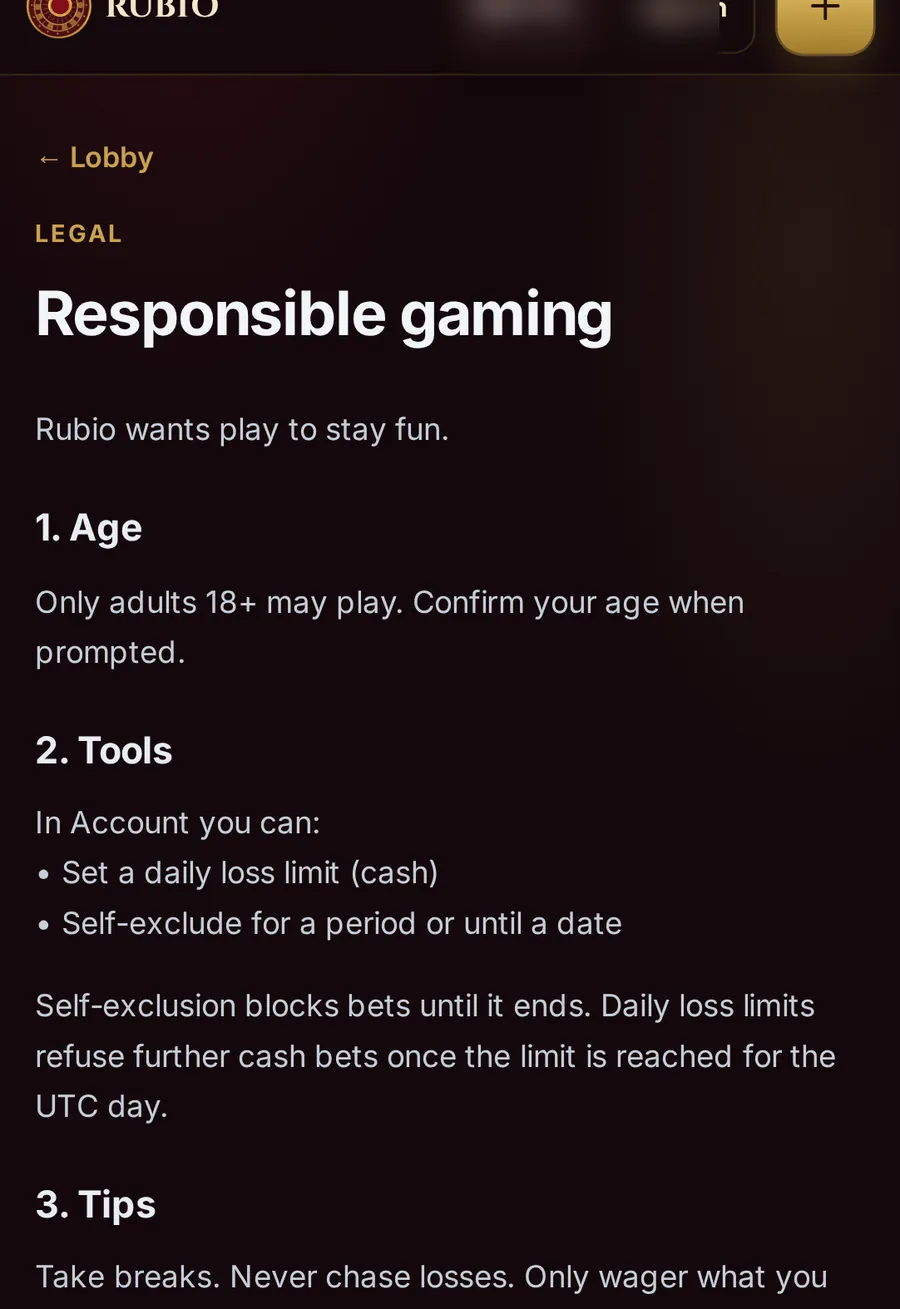
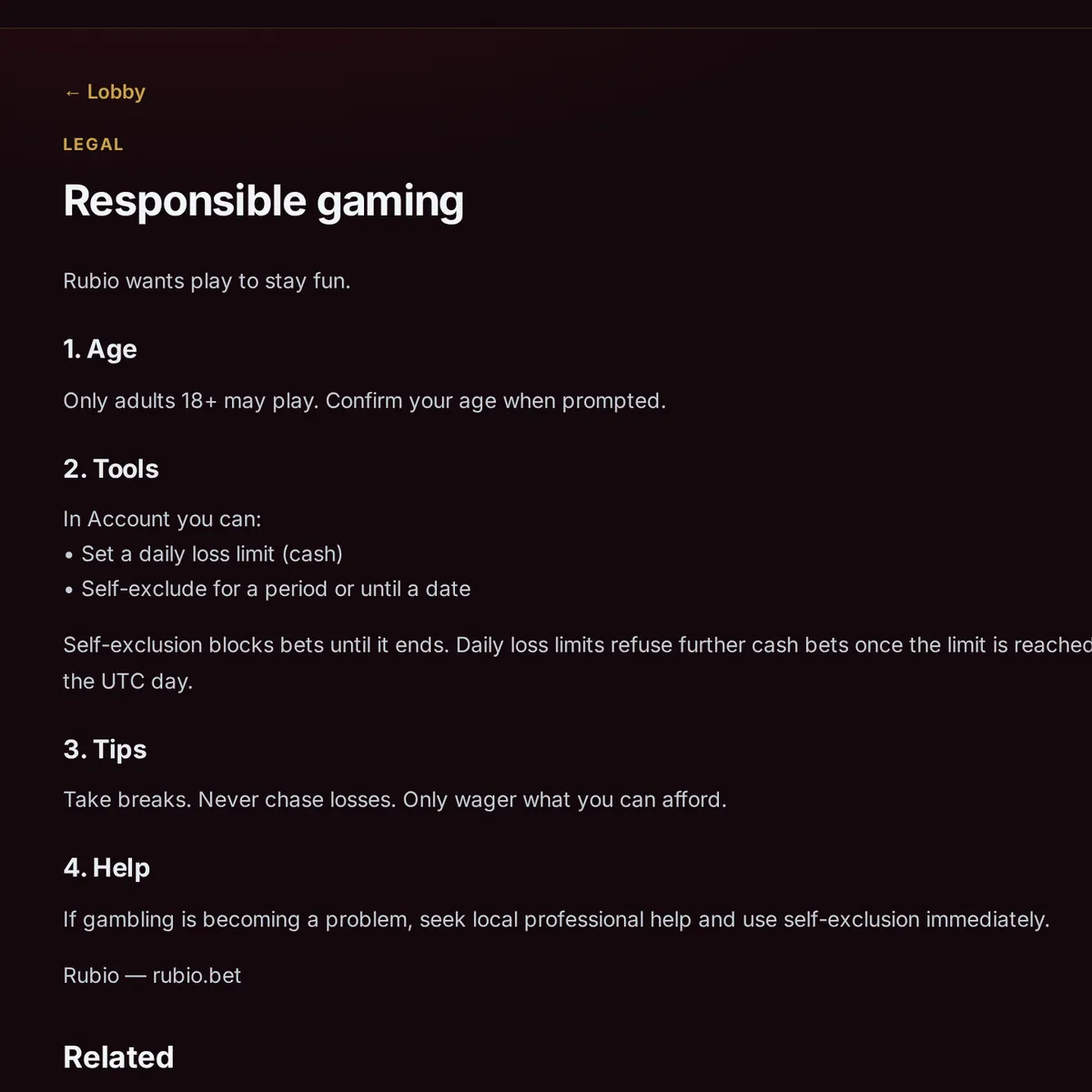
From the sites we have reviewed this year, a common baseline is:
- an 18+ confirmation before play,
- a daily cash loss limit set in the account, and
- self-exclusion for a number of days or until a date, which blocks bets until it ends.
That is a reasonable start. The most common gaps are deposit limits, time-outs, session reminders, and help links on the responsible gaming page itself. Some sites also let players shorten or end a self-exclusion straight away, which undermines its purpose.
How players can fill the gaps
If your site lacks a tool, you can build most of it yourself:
- Deposit limit: keep gaming funds in a separate exchange sub-account and move a fixed amount once a month. When it is gone, it is gone.
- Reality check: set a recurring phone timer. Thirty minutes is plenty in fast games.
- Time-out and exclusion: blocking software such as BetBlocker (free) blocks gambling sites across your devices and cannot be switched off on a whim.
- Accountability: tell someone you trust what your monthly budget is.
Signs it is time to use the tools
- Spending more time or money than planned, repeatedly.
- Raising stakes to recover losses.
- Hiding gambling from family or friends.
- Feeling irritable when trying to cut back.
Free, confidential support is available from Gambling Therapy in many languages and from Gamblers Anonymous groups worldwide.
What operators should do next
For crypto casinos that want to be taken seriously, the next steps are not expensive: delay limit increases, make self-exclusion irreversible for its chosen period, add deposit limits and time-outs, show a reality check in long sessions, and link help services directly from the responsible gaming page. All of these are standard features that players should expect.
A five-minute set-up before your first deposit
- Find the responsible gaming page and the limits section of your account.
- Set a daily loss limit at a level you would be comfortable losing every day of the week.
- Note how to self-exclude and how long the shortest option is.
- Install a free blocker if you think you might need a break later. It is easier to do while calm.
- Write your monthly budget somewhere you will see it.
What good looks like, in one table
| Tool | Minimum standard | Better |
|---|---|---|
| Loss limit | Player can set a daily limit | Daily, weekly and monthly, with a cooling-off delay before raising |
| Self-exclusion | Fixed period, blocks bets | Choice of periods and dates, blocks deposits too |
| Age check | 18+ confirmation | Confirmation plus checks before withdrawal |
| Help links | Generic advice | Named, free support services |
Use the table to compare sites, then set your own limits regardless of what the site offers.
If you already feel it is too much
Do not wait for a perfect plan. Self-exclude now, block the site on your devices and talk to a free support service. You can always revisit the decision later; it is much harder to undo losses.
Free tools such as BetBlocker work across devices and cost nothing to set up, which makes them a sensible addition to any site's own limits.
FAQ
Do crypto casinos have to offer these tools?
It depends on the jurisdiction they are licensed in. Regardless of rules, a site that offers none is telling you how it views its players.
Is self-exclusion at one site enough?
Often not. If you need a break, use blocking software too, because other sites are a click away.
Does a loss limit include wins?
Usually it tracks net cash losses for the day. Check the site's definition.
18+ only. If gambling is causing harm, stop and seek help.