Crypto casino originals explained: dice, crash, mines, pump, limbo and RPS
How the in-house games that define crypto casinos actually work, what their odds look like, and how each one feels to play, with screenshots from practice mode.
Walk into any crypto casino lobby and the first row is rarely slots. It is a set of simple, fast in-house games usually called "originals": dice, crash, mines, plinko, limbo and newer variations like pump or rock–paper–scissors. They exist because they are easy to make provably fair, easy to understand and quick to play on a phone.
Here is how six of the most common ones work, with the odds from one operator's published rules as reference points. Other sites use the same ideas with different numbers.
Dice: choose your own probability
You pick a target between 0 and 100 and bet the roll will land over or under it. The roll comes from one HMAC-SHA256 output scaled to 0–99.99. The payout multiplier is simply return ÷ chance: at a 3% edge, a 50% chance pays 1.94× and a 10% chance pays 9.70×.
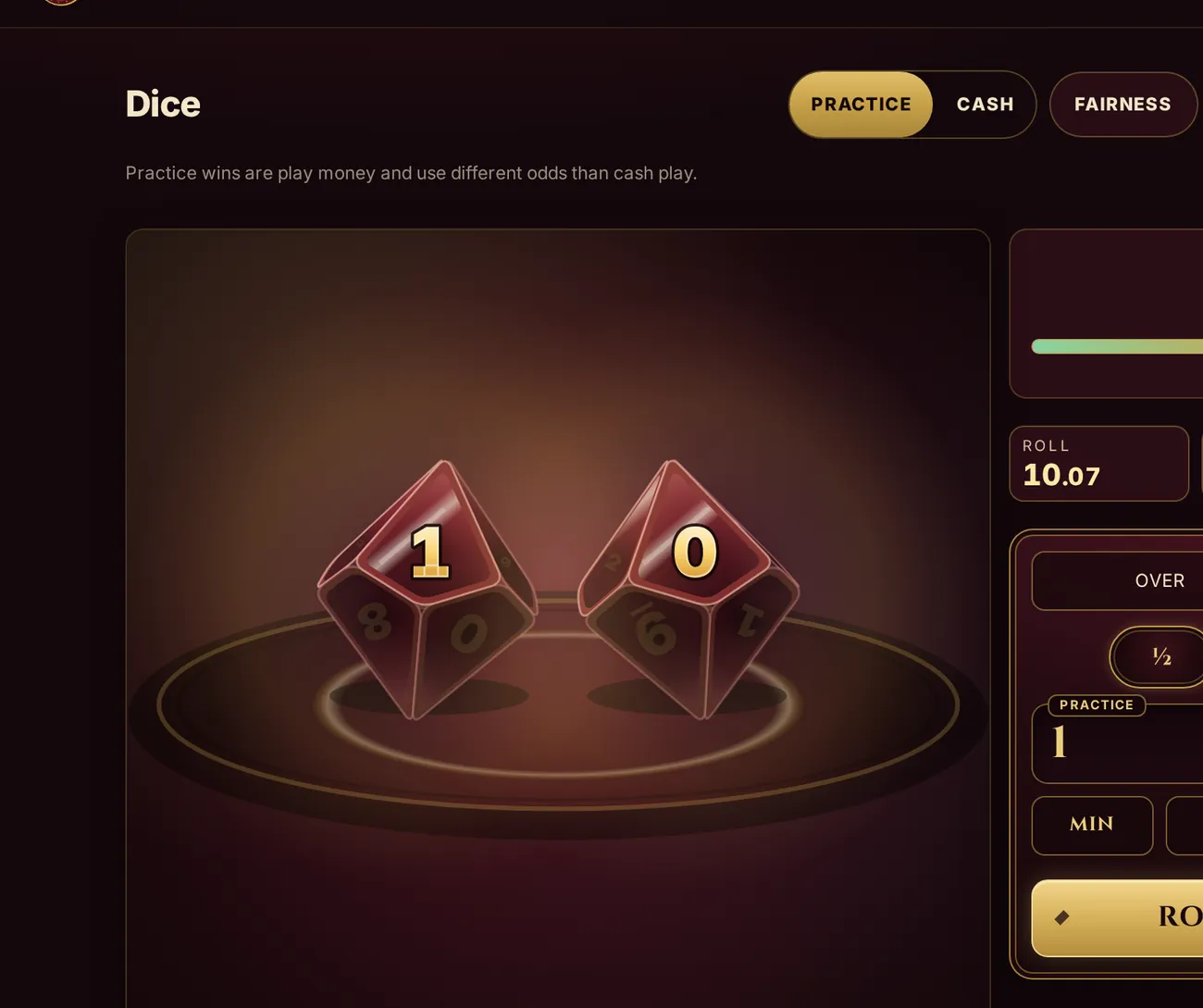
How it feels: calm and mathematical. It is the best game for learning how probability and payouts trade off.
Crash: the shared rocket
A multiplier rises from 1.00× until it "crashes" at a random point. Everyone at the table sees the same round. Cash out before the crash and you win your stake times the current multiplier. Rounds come from a pre-generated hash chain. At a 4% edge, about 4.95% of rounds crash instantly at 1.00×, and the chance of reaching a target is roughly 96 ÷ target.
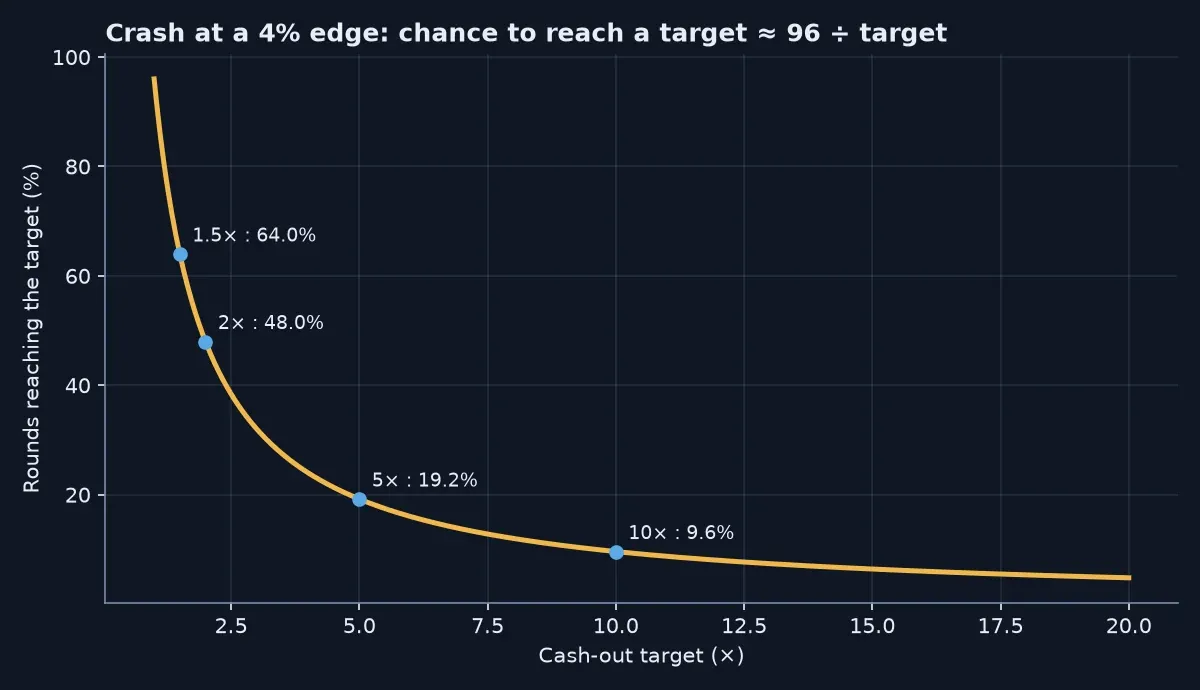
How it feels: tense and social. Auto cash-out is your friend. You can see how it plays in Rubio's crash game, which shows the previous rounds' crash points along the top.
Mines: decide when to stop
A 5×5 grid hides a number of mines you choose. Each safe tile raises your multiplier; a mine loses the stake. The layout is fixed by a seeded shuffle before your first click. With 3 mines, the first safe pick pays about 1.10× and five safe picks about 1.96×.
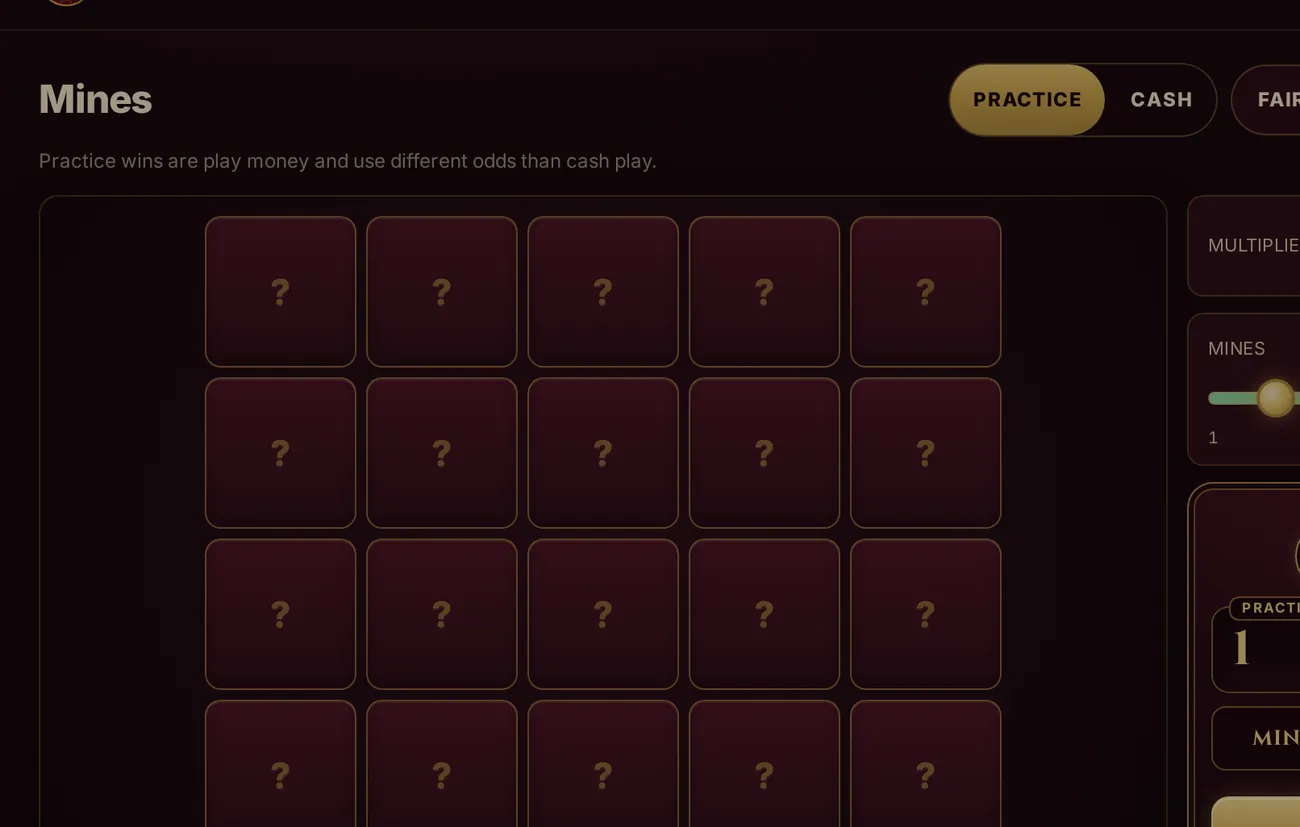
How it feels: a test of discipline. The expected return is the same whenever you stop; only the risk changes.
Pump: the balloon
Each pump raises the multiplier by a fixed step, and the balloon may burst on any pump. The burst point is decided when you start. On the version we studied, surviving to 1.96× happens about half the time, and all 30 pumps clear about 21% of the time.
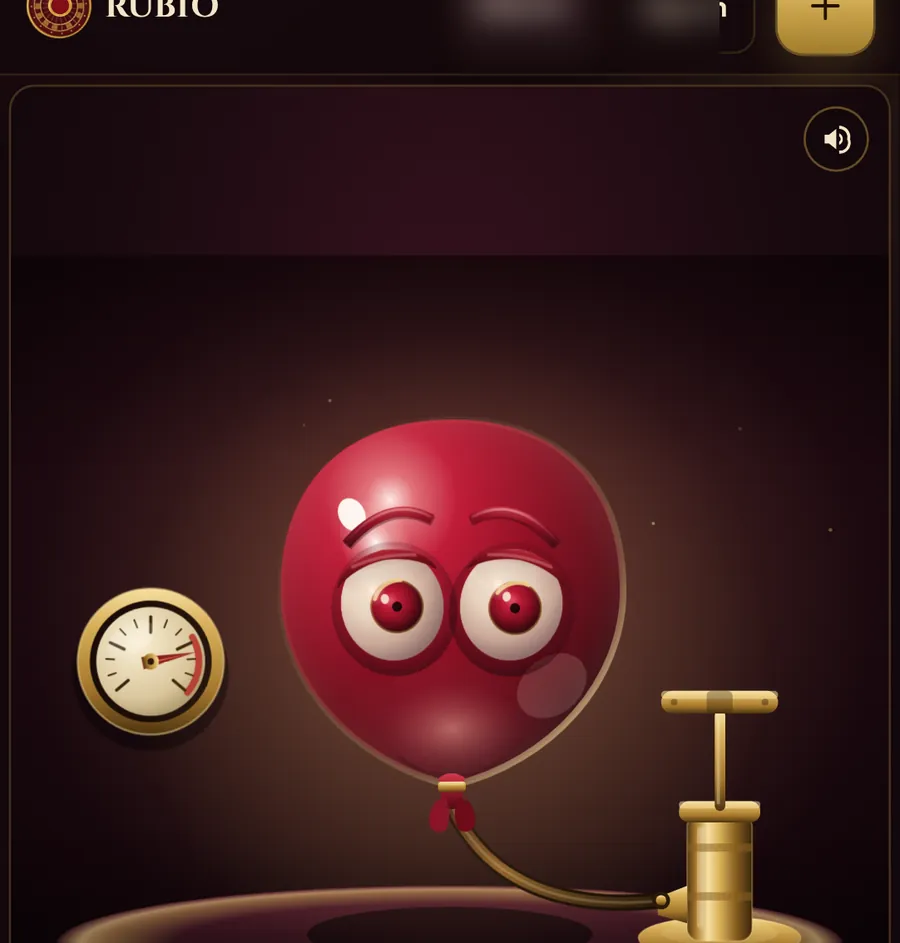
How it feels: like crash but in your own hands and at your own pace.
Limbo: one number, instantly
Pick a target multiplier. The game draws a result; if it is at least your target, you win the target. The chance of winning is about return ÷ target: 48.5% at 2×, about 0.97% at 100×.
How it feels: crash without the wait. Very fast, so watch your pace.
Rock–paper–scissors: the house picks a hand
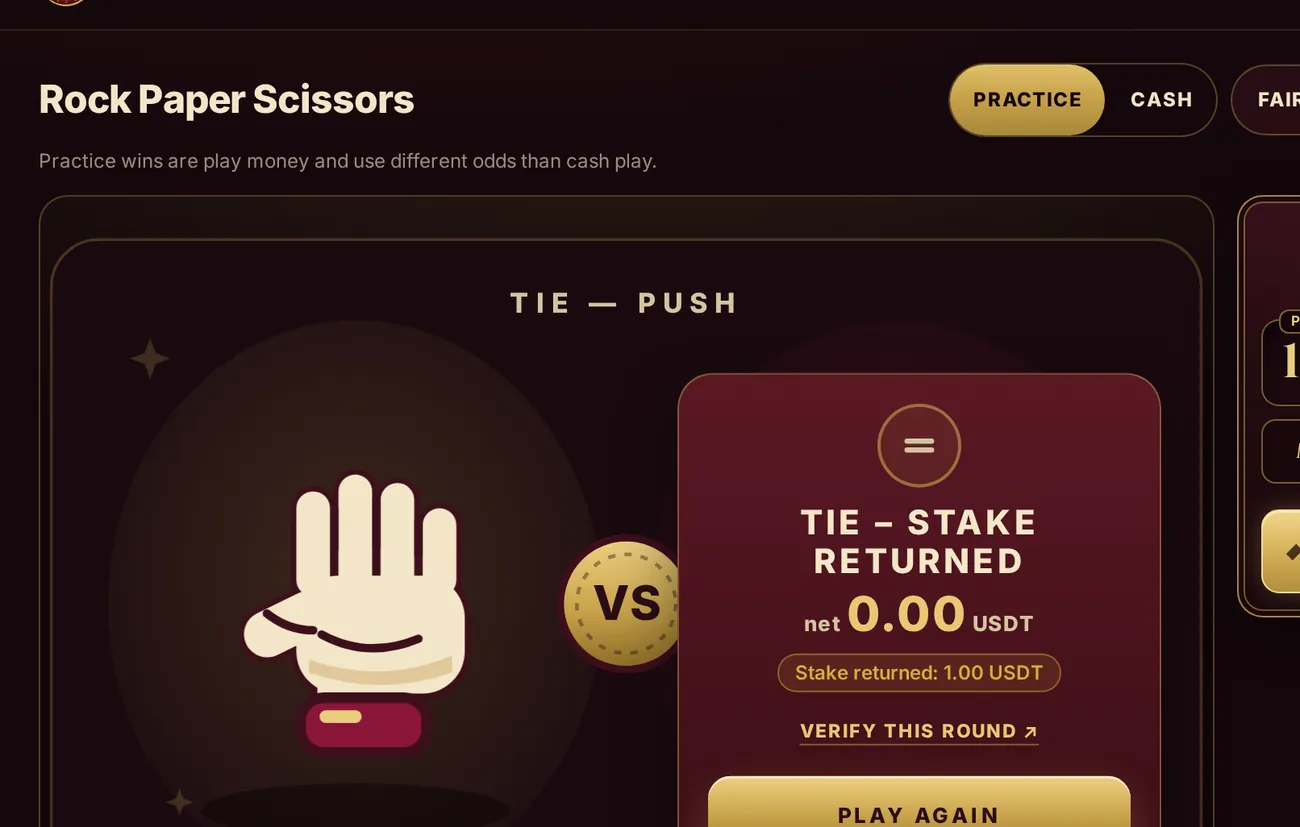
You choose a hand; the house hand comes from the seed. A win pays 1.91× at a 3% edge and a tie returns your stake, which keeps variance low.
Side-by-side
| Game | Typical cash RTP | Variance | Pace |
|---|---|---|---|
| Dice | 97% | You choose | Very fast |
| Crash | 96% | High | Shared rounds |
| Mines | ≈97% | You choose | Medium |
| Pump | 97% | You choose | Medium |
| Limbo | 97% | You choose | Very fast |
| Rock–paper–scissors | 97% | Low | Fast |
What all six have in common
Under the different graphics, every game here does the same three things:
- Commit: the operator shows the hash of a secret server seed before you play.
- Compute: the result comes from HMAC-SHA256 of that seed with your client seed and a counter, plus a game tag where needed.
- Price: the payout is the fair price of the outcome multiplied by the RTP.
That shared structure is why you can check any of them with the same handful of tools, and why choices inside a game change variance rather than value. If a new original appears in a lobby next month, those three questions are the ones to ask: how is the result committed, how is it computed, and what is the price formula?
Speed and session cost
The six games also differ in pace. Dice, limbo and coin flip resolve instantly, so a player can place hundreds of bets an hour. Crash runs on shared rounds, which naturally slows play. Mines and pump depend on how many steps you take. Because the edge applies to every bet, the faster games cost more per hour at the same stake, even when their percentage edge is lower than crash's. If you want a session to last, choose a slower game or slow yourself down.
FAQ
Are originals better odds than slots?
On the published figures we looked at, most originals return about 97%, while the slot-style games return about 95% before any max-win cap.
Can strategy change the odds in these games?
No. Choices change variance, not the house edge.
Why do crypto casinos favour these games?
They are cheap to build in-house, easy to verify and work well on phones.
18+ only. Gambling involves risk of loss.