The 2026 crypto casino trust checklist: 15 signals, ranked by how hard they are to fake
Badges and testimonials are cheap. Published formulas, on-chain payouts and enforced restrictions are not. A ranked checklist for judging a crypto casino before you deposit.
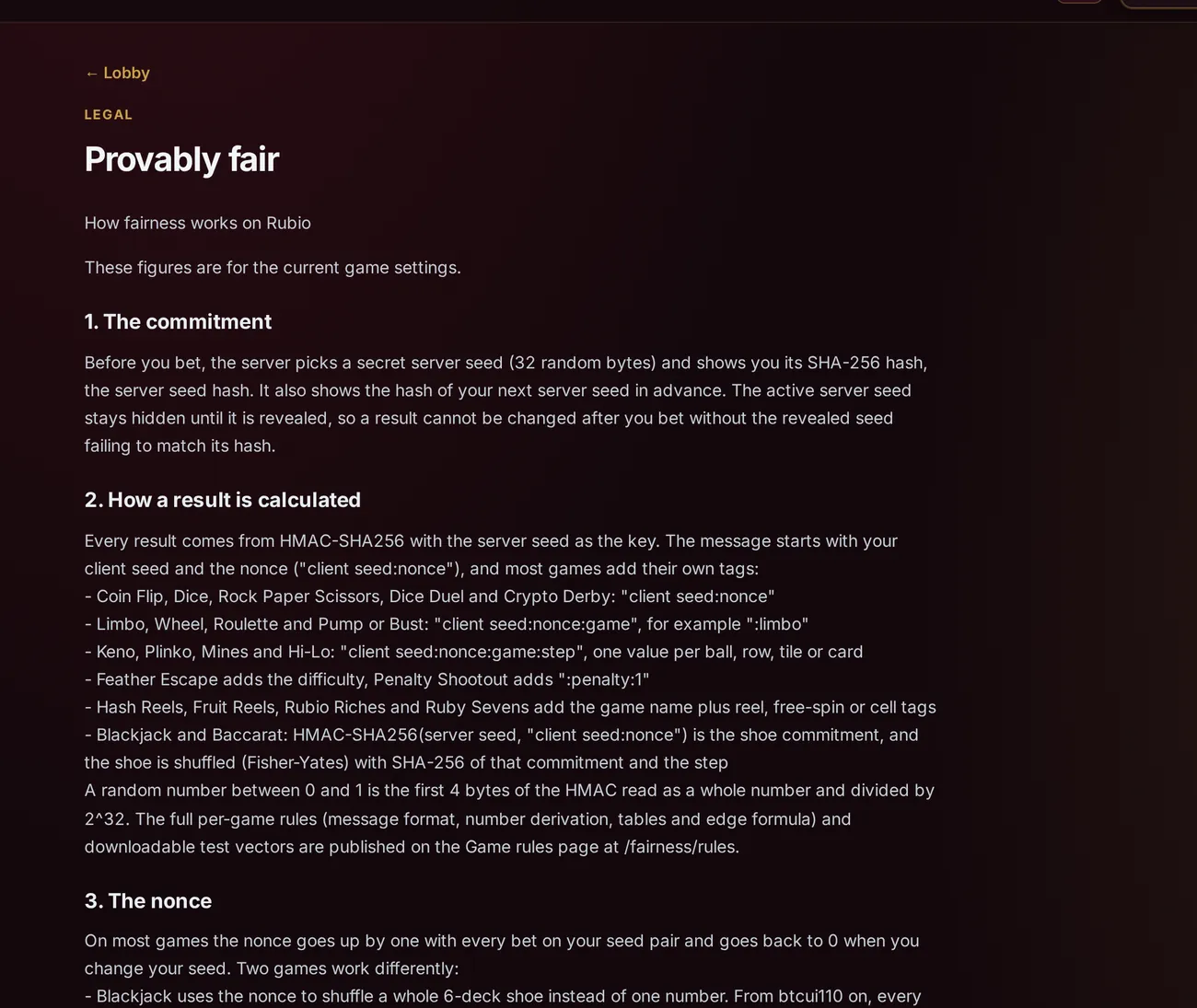
Every crypto casino says it is fair, fast and safe. The useful question is not whether a site makes those claims but how expensive each claim would be to fake. A trust badge costs nothing to paste into a footer. Publishing exact game formulas that strangers can test costs real engineering effort and exposes the operator to being caught.
We rank fifteen signals into three tiers. Use the top tier to decide, the middle tier to compare, and treat the bottom tier as decoration.
Tier 1: hard to fake (decide on these)
1. Your own withdrawal, verified on chain. Deposit a small amount, withdraw it, and look up the transaction ID on a public explorer. Recipient, amount, token contract and timestamp are all public. Nothing beats this.
2. Recomputable game results. The site publishes the HMAC message format, the number derivation and the payout formula for each game, ideally with test vectors. If your own code reproduces the published values, the documentation is real.
3. An independent checker. A verifier that runs in your browser without calling the operator's server, or one you write yourself, means you are not asking the casino to grade itself.
4. Per-game RTP with a date. "RTP up to 99%" is marketing. A table listing every game's return, the edge used and the date it applies to is a commitment.
5. Per-bet records. The edge and game version stored with each bet let you check that the odds you played at are the odds you were promised, even if settings change later.
Tier 2: costly to fake (use to compare)
6. Disclosed limitations. Operators that state what their system does not prove, such as a crash hash chain whose seed was chosen by the house, are giving you information that costs them marketing appeal.
7. A visible max-win cap. Caps are normal. Disclosing them before you play, and showing the capped amount at cash-out, is the honest version.
8. Enforced geo-restrictions. Blocking countries where a site cannot operate costs revenue. A site that serves everyone regardless is telling you something about its approach to rules.
9. Clear payment rules. Minimums, maximums, fees, review times and confirmation counts written down before you deposit.
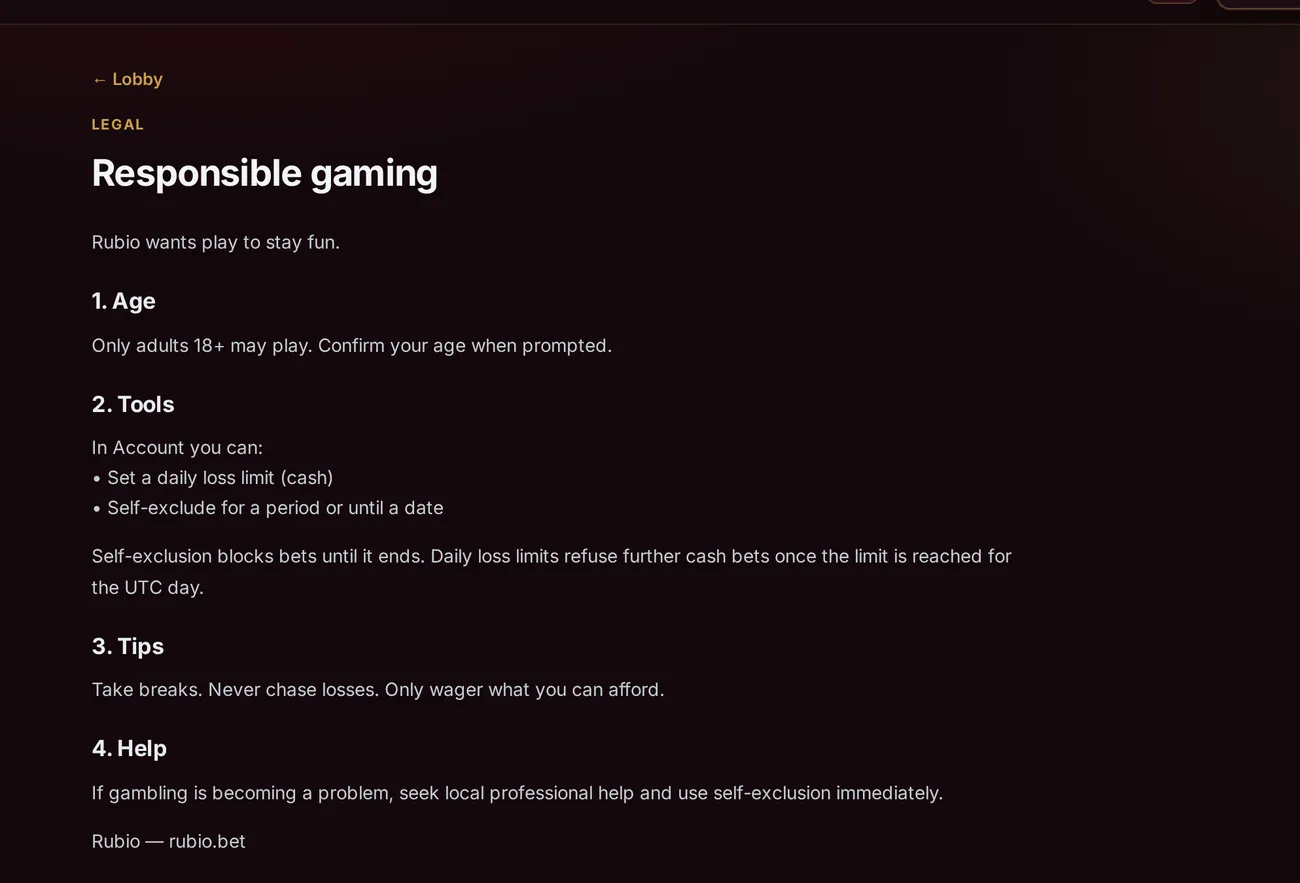
10. Working player-protection tools. Loss limits and self-exclusion you can set yourself in the account, without emailing support.
11. Practice-mode honesty. If play-money odds differ from cash odds, the site says so, and practice bets are labelled in public feeds.
Tier 3: cheap to fake (decoration)
12. Trust badges without a link to a verifiable registry entry.
13. Win tickers and "big wins" feeds, which may mix play-money and cash results.
14. Star ratings and testimonials with no way to check the author.
15. "Instant withdrawals" banners. Speed claims mean little until you test them.
How to run the checklist in 20 minutes
- Open the fairness and rules pages. Look for message formats, test vectors and an RTP table. (Signals 2, 4, 5, 6)
- Open the payments page. Note limits, fees and review time. (9)
- Open the responsible gaming page and the account settings. (10)
- Open a game in practice mode and compare its multipliers with the cash RTP. (11)
- Plan a small deposit-and-withdrawal test. (1)
For step 5, keep the amount small, record the destination address and the TXID, and confirm the payment on a public explorer — mempool.space for Bitcoin, Tronscan for TRC20 — rather than relying on the operator's status page alone. If the TXID never appears, or the amount or address does not match, treat that as a failed test.
What about licences?
A licence adds a supervisor and a complaints route, which is valuable. Licences differ widely in how much they demand, though, and logos are easy to copy. Always click through to the regulator's own register and check the licence number and the legal entity name match the site's terms.
Scoring a site in practice
You can turn the checklist into a quick score. Give each Tier 1 signal 3 points, each Tier 2 signal 2 points and each Tier 3 signal 0 points, whatever it shows. A site that scores well on Tier 1 and Tier 2 has made itself checkable. A site whose "trust" rests on badges, tickers and testimonials has not, however polished it looks.
Two warnings. First, a high score is not a guarantee; it means the site has exposed itself to verification, and you still need to do the verifying. Second, signal 1, your own withdrawal, outweighs everything else combined. A perfect documentation score means little if your test withdrawal does not arrive.
Signals that should make you walk away
- A requirement to deposit more before a withdrawal can be released.
- Withdrawal rules that appear only after you request a payout.
- Claims of licences that cannot be found on the regulator's public register.
- Support that refuses to give a reason for a rejected withdrawal.
Re-run the checklist every few months: terms, limits and payment rules change, and a site that scored well last year deserves a fresh look.
FAQ
Which single signal matters most?
Your own successful withdrawal with a transaction ID you checked yourself.
Are review sites a trust signal?
Only if they show their method and what they could not verify. Many are paid per sign-up. Prefer reviews that list limitations.
Does provably fair mean the casino is trustworthy?
It means results were not changed after you bet. It does not cover odds, payments or how the operator treats players.
18+ only. Gambling may be illegal where you live.